Minutes from Manhattan, this first Garden Community in Queens boasts paths that penetrate each block under an umbrella of London plane trees. This urban delight boasts one of the two private parks in New York City! For further information, call the Sunnyside Foundation for Community Planning and Preservation at 718-392-9139.
This revolutionary development set a seldom-equaled precedent for open space and apartment house design. It contains special design and landscape features which are reminiscent of those in a well-established urban park. Spectacular shade trees, meandering paths and well-placed sitting areas give Boulevard Gardens its special character as a model village. Landmark quality.
NORWOOD GARDENS
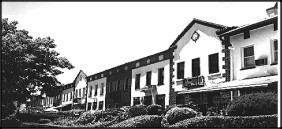
The red brick and white stucco is accentuated by iron balconies and lattice work.
The cornices of tiles or brick are a pleasing contrast. Deep front yards with a variety of evergreens and flourishing shrubs make
36th Street between 30th Avenue and 31st Avenue delightful block. A landmark worthy community.
A group of two-story brick houses stands on 20th Avenue and 41st Street. They boast stone window lintels and recessed entrances. Built before 1880, they are Landmark quality homes.
DITMARS - ASTORIA PARK
Located in northern Long Island City between La Guardia Airport and the East River. This lively neighborhood has attracted the largest Greek community outside Athens.
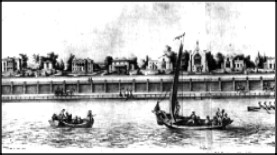 Currier & Ives:
This community lies on the East River shore north of the Queensborough Bridge and south of Old Astoria. Mid-nineteenth century mansions lined the East River until overwhelmed by industry at the turn of the century.
Today, some remain waiting for you to find them! Home to the Noguchi Museum, the Socrates Sculpture Garden, Ravenswood is one of Long Island City's secret delights!
This community, one of the first European settlements in Queens, started from Dutch land grants along an arm of Newtown Creek (Dutch: Newtown Kills).
Today, a vibrant neighborhood north of Queenborough Plaza maintains a 350 year tradition. Look for the attractive community banners placed by the Dutch Kills Civic Association. Architecturally distinguished, St. Patrick's Church recently celebrated its centennial.
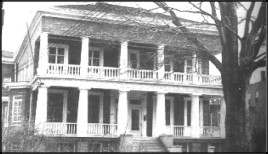 "Rosemont", built in 1852
The Village of Astoria, developed in 1839 by Stephen A. Halsey, still exists! Ante-bellum mansions, quaint workers' cottages, churches and cemeteries echo a vanished age. This intact district, unique to New York, offers a rare glimpse of a nineteenth century Long Island town.
Homes, lovingly restored, surprise Queens native and tourist alike. Don't miss the small Irish "Famine Cemetery" on 21st Street.